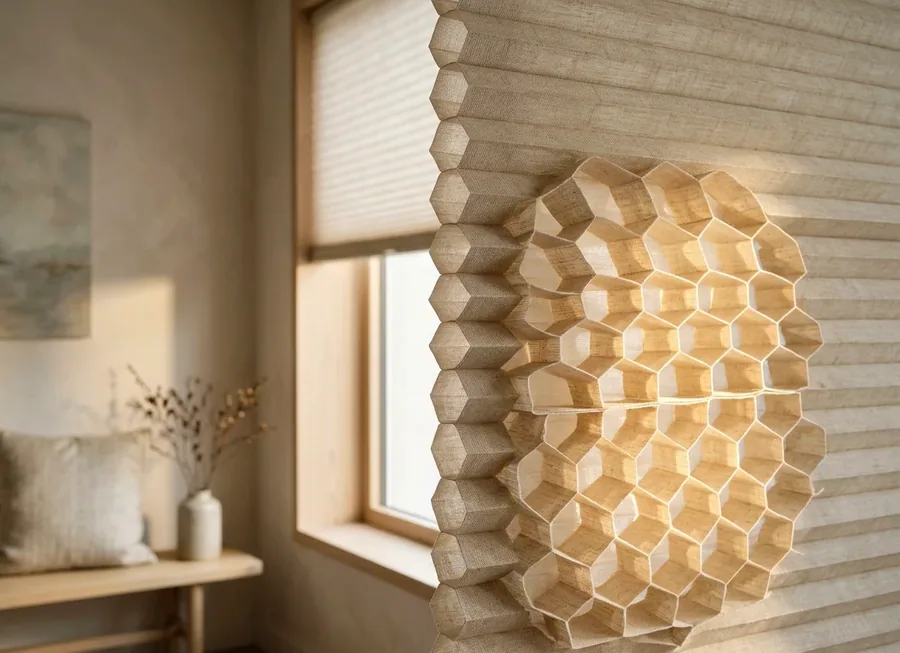
Pleated fabric forming hexagonal air cells — trapped air that insulates the glass in both directions. On a new estate, before the garden's grown in to help, that buffer does more of the work.
01
Why this matters more on a new stand
An established Johannesburg garden shades a good part of a home's glass by mid-afternoon. A newly planted Helderfontein garden doesn't — not for years. Until then, a cellular blind's trapped-air structure is doing some of the job the trees will eventually take over: a soft thermal buffer that keeps rooms more comfortable in both directions, and quieter too, since the cells absorb sound as well as heat.
We keep the claims honest — comfort and a lower heating/cooling load, not invented percentages.
02
Single cell, double cell, and where each earns its keep
Single cells suit milder rooms and lighter budgets. Double cells are the serious thermal option — worth the extra spend on the room above the garage that's always the coldest in winter and hottest in summer, a familiar complaint in double-storey new-estate builds.
03
Operation and shape options
Top-down/bottom-up operation gives privacy at the bottom with light and sky at the top — useful for street-facing new-build windows before hedging or boundary planting has filled in. Cordless and motorised operation are both available; see our automation page for whole-house control. The cell structure also holds its shape on skylights and angled glass, which flat fabrics can't manage as cleanly.
Blockout cell fabrics available for genuine bedroom darkness, with the thermal bonus included
The slimmest stack of any blind when raised — near-invisible on minimalist new-build reveals
A genuine option for nurseries — dark, quiet and warm in one product
Double-cell and top-down/bottom-up versions sit at the upper end of the price range — we'll show you where single-cell does the job just as well.
That insulation buffer matters most where a garden hasn't had time to grow in yet — which describes most of this corridor. We fit cellular and honeycomb blinds in new and recently-landscaped homes across Fourways, Dainfern, Broadacres & Cedar Lakes and Steyn City, not only inside Helderfontein Estate.